
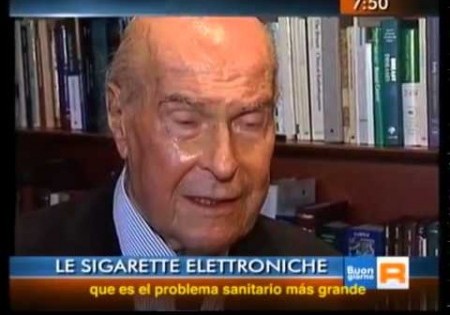
For one who has been dealing and treating cancer most of his professional life, Dr. Umberto Veronesi knows what he is talking about insofar as lung cancer is concerned. This Italian surgeon who is also the scientific director of European Institute of Oncology, a non-profit comprehensive cancer center, has lately shared his professional opinion about electronic cigarettes. As one who has dealt with pain and deaths due to lung cancer, his opinion carries much weight at a time when the WHO released an “alarming” report on electronic cigarettes.
Veronesi E-Cig Experience
Long before E-Cigarettes made it big in the smoking circles, Dr. Veronesi has already joined other medical experts in Italy such as Carlo Cipolla (European Institute of Oncology), Umberto Tirelli, (National Cancer Institute in Aviano) and Ricardo Polosa (University of Catania) in preaching about its potential benefits. Nobody prompted him; his encounters with his lung cancer patients convinced him that it is a less-harmful alternative worth trying.
He came out with his medical opinion about electronic cigarettes when it came under fire in view of the “alarming” WHO report. For this oncologist, the report made an offhand “attack on E-Cigarettes in the guise of precautionary principle, which he views as “nonsense.”
Sharing Opinion with Other Experts
Dr. Veronesi is not the only one with a healthy opinion about E-Cigarettes. He joined 49 other health experts from the U.S. and Europe in asking the World Health Organization not to issue prohibitions on electronic cigarettes. Daniel Sarewitz, co-director of Arizona State University’s Consortium for Science, Policy and Outcomes, believes that waiting for the results of studies about effects of long-term use can waste time while millions of smokers die each year. Not that these studies are unimportant; they just believe that it is insensible to attack a product that every expert claims to have less detrimental effects than lighted cigarettes.
Dr. Umberto Veronesi explained in the article published in La Repubblica that the combustion temperature causes the tobacco to release over 13 (carcinogenic) polycyclic hydrocarbons as well as dozens of other carcinogens drawn into lungs upon smoking. Electronic cigarettes do not burn tobacco or paper; it merely consists of safe ingredients such as propylene glycol and vegetable glycerin.
Reading Between the Lines
Dr. Veronesi, along with the other health experts, could not help but think there is more to the attacks on E-Cigarettes despite being less harmful. The threat it imposes on traditional cigarettes that can reduce the profits of the tobacco growers and cigarette manufacturers is sensed to be behind the attacks. The restrictions made on electronic cigarettes can give them time to reposition their strategies to better deal with E-Cig threats.
Every business has to play that kind of game, E-cigs included. Veronesi is hoping, however, that it will not get to that point when influential global health organizations will be used to the detriment of public health. Sarewitz disparagingly noted that the hypothetical risks alluded to by the World Health Organization are disproportionate to the inevitability of lung cancer.
At this point in time, health experts who believe that E-cigarettes pose fewer risks than traditional cigarettes must exert effort to join forces and to pressure global organizations to review their policies and restrictions. Nothing can be more convincing than coming out with scientific evidences concretely proving E-Cigarette’s safety and efficacy.
Veronesi suggested a couple of studies. One was undertaken at theUniversity of Catania on mixing research and marketing, and the other was a study by the European Institute of Oncology that didn’t observe a single case of side-effects or toxicity with its use.