
One of the lesser discussed topics in the vaping world is nicotine delivery, yet it is one of the most important and impacting performance factors. Although it is not a mystery to most users of e-cigs and mods alike, news stories and studies on the subject are scarce, but it is often mentioned in various studies and while refuting false claims often made about the products. What is nicotine delivery, exactly? It is the measured amount of nicotine that enters your bloodstream, from smoking, vaping or using other nicotine alternatives such as gums and patches.
When it comes to electronic cigarettes, nicotine delivery has often been studied and shown to be slower and lesser than analogue tobacco cigarette smoking. This usually translate in a lack of satisfaction for first time users of e-cigs and requires and adaptation period where the body gets used to not getting the nicotine delivered as quick.
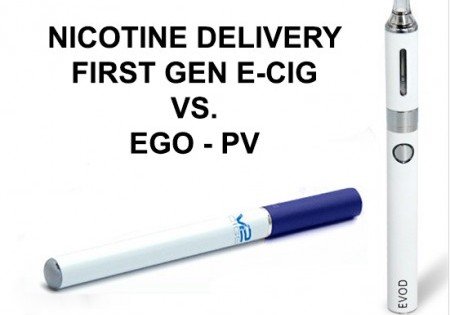
Traditional cigarette look-a-like electronic cigarettes we’re the first generation vaporizers that blew the lid off vaping instead of smoking. Quickly after, personal vaporizer mods started surfacing. People we’re putting together devices with more power, and modifying atomizer coils by lowering the resistance, creating more vapor. That is where the ‘MODS’ name for PV’s comes from. A recent study compared the nicotine delivery levels between first generation e-cigs and personal vaporizers. Dr. Konstantinos Farsalinos and his team produced data allowing a proper judgement of the effectiveness of nicotine intake users get from both types of handheld vaporizers. The study was done on a small group of 23 participants and offers a solid stepping stone for further studies.
Electronic Cigarette Look-a-Likes vs. Personal Vaporizer MODS – PVs
Overview:
23 people participated in the study. On the first test, they were given 18m/ 1.8% nicotine strength e-liquid and a V2 Cigs e-cigarette device to use as well as a more powerful eVic Personal Vaporizer MOD device to vape with. A wait period of at least 8 hours devout of any nicotine, caffeine and food consumption was completed before each measurement test. The e-liquid was analysed and found to be 0.3mg lower than the rated 18mg. They also tested for harmful toxins and only found trace amounts.
All 23 study participants we’re ex-smokers that had completely switched to vaping for a minimum of one month. All of them had been heavy smokers and 20 of them we’re capable of giving up smoking after a single month of vaping while the remaining 3 had longer varied transitioning periods. More than half had tried other quitting methods and failed before giving e-cigs a shot. The measured levels of intake obviously show a lower consumption rate of nicotine compared to when they we’re smokers, which is a very interesting fact to take into account. The study referred to e-cigarettes as first generation devices and personal vaporizer mods and new generation devices, as shown in the graph below;
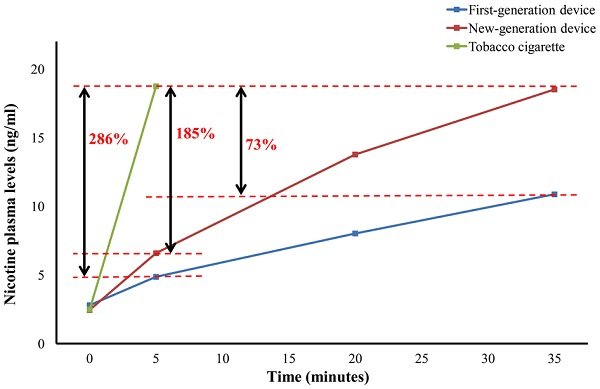
Blood nicotine readings were measured in each participant over an hour long period during calculated intervals and puff counts. The findings were compared to each other, as well as previously published measurements of nicotine deliver from smoking a tobacco cigarette.
The results showed that Personal Vaporizers (MODS) delivered higher nicotine levels in the blood stream than electronic cigarette look-a-like devices. The sheer size difference and power output between e-cigarettes and PVs obviously had everything to do with the results. The extra power created more vapor by heating the e-liquid at higher temperatures than a small e-cig battery and atomizer is capable of attaining.
When looking at numbers, the two devices performed at very similar levels until the 20 minute mark of using them, where PVs soared higher than e-cigs in terms of nicotine levels entering the blood stream. The difference was shown to be as high as 70% more when using a MOD over an e-cigarette, but slowly decreases a little bit past the first 30 minutes of usage.
When comparing the stats to an analogue tobacco cigarette over the first 5 minutes showed that smoking tobacco greatly surpassed nicotine delivery as much as four times more than e-cigs and three times more than personal vaporizers. The measurement was limited to 5 minutes, as that is the average time taken to smoke a cigarette, while vaporizer users will use it for extended periods of time. It takes on average 35 minutes for a user to get the same nicotine level from a PV when compared to 5 minutes of smoking a cigarette.
The study results revealed and estimated that it would take 50mg or 5% nicotine strength e-liquid to match the same nicotine deliver a user gets from smoking a tobacco cigarette, advising that limiting nicotine strengths to industry standards of 24mg isn’t sufficient to satisfy regular smokers, pushing them back to smoking. But is that fact and is increased nicotine levels the best way to go?
Conclusion
Although the study was very small, it succeeded and providing accurate and valuable data the researchers set out to discover. A V2 Cigs electronic cigarette was put against an eVic EVOD running at 9 watts and participants were tested using each device on different days and the results favored the Personal Vaporizer by as high as 70% after 20 minutes of usage and reduced to 49% after 65 minutes. PVs deliver more nicotine, but still have a similar delayed amount of time before the nicotine levels start to significantly rise in the user’s bloodstream. Compared to smoking, the nicotine is delivered almost instantly and at much higher levels than any vaporizer.
The most important information to take from these observations, is that plasma nicotine levels from e-cigarettes and vaporizers are very different than smoking tobacco cigarettes. The intake is much slower and can take up to 20 minutes and still do not deliver the same amount of nicotine as analogue cigarettes. This makes it hard for someone to instantly quit smoking in favor of vaping, due to being satisfied from smoking right off the first few puffs. The study suggests that nicotine strengths need to be set higher to instantly satisfy e-cig users and it makes sense, but it may be wise to take it slow and not boost levels too high.
One must look at why e-cigarettes provide less nicotine to have a better understanding of it all. But keeping it basic, it is not necessarily a bad thing that all ex-smokers now turned vapers, are consuming significantly lower levels of nicotine than smokers. However, there are downsides for heavy smokers who wish to quickly switch to vaping. They must vape for much longer periods to get the satisfaction needed to cut the cigarette craving, and the whole subject deserves much attention, research and development to better serve everyone.