
TORONTO –  The recent new rules that were introduced which meant the prohibition of e-cigarette and medical marijuana users throughout Ontario of smoking or vaporizing in areas where the smoking of traditional tobacco cigarettes are prohibited. This comes as a draconian position unless and until the Liberal government decides on any future changes. To some, such as Premier Kathleen Wynne, the new rules come as common sense due to the similarities between smoking cigarettes and smoking medical marijuana and vaping e-cigarettes.
“We have made a determination that smoking, whatever it is whether it’s vaping, whether it’s medical marijuana, whether it’s cigarettes – that there should be restrictions on that,” she stated on Thursday. “And so the rules will apply to marijuana, to medical marijuana, to vaping as they do to cigarettes.”
These new regulations were introduced months after the Liberal government had backtracked on the initial electronic cigarette regulations only one day after an exemption for medical marijuana was brought to the table.
The intention was for the e-cigarette rules to take effect on 1 January 2016 in order to prohibit its use in public areas, the work place and particular outdoor areas which have been classified as non-smoking areas.
However, once the medical marijuana exemption was made known to the public, several hundreds of advocates for medical marijuana and e-cigarettes took the stance of protesting against the draconian new rules. This resulted in a backlash against the government and the government was forced to draw back the rules, putting them on hold, whilst having to work their way back to the drawing board to come up with a friendly solution that would appease the majority of those affected.
As a result, the new rules have been submitted for consultation within the next 45 days. Dipika Damerla, the Health Minister, stated that there will not be any ruling out of any changes to the rules once the consultation period comes to an end.
When questioned on whether the introduction of such rules made for a better balance, Damerla said “We committed to reviewing the regulations around medical marijuana and we’ve kept our commitment.”
The founder of the Canadians for Fair Access to Medical Marijuana, Jonathan Zaid, applauded the original exemption advocating that the users highly depended on their medication to living a higher quality lifestyle.
On Thursday, after the changes were made by, Zaid expressed his deep disappointment on how the government had reversed its position thus giving false hope and expectations to the public.
“I thought the government was willing to work with medical cannabis users to create a regulation and an exemption that works for both the public health and public safety and medical marijuana users, but it seems like this backtrack has kind of made it fully inaccessible for people to use their medicine, which I believe is against their human rights.”
Opposition parties took this opportunity to criticize the government’s action. France Gelinas, a health critic of the NDP, shot the Liberals down saying that they should have made the rules clear when the legislation was drafted and passed last year.
“This extended period of time makes it worse and makes it even more polarized than what we had before,” she said. “We had a chance to be ahead of this. We wasted that op portunity.”
The new rules which are set to be in force on 1 July 2016 are to expand the definition of “e-cigarette” to include all “e-substance”. It also intends to expand the list of ares where e-cigarettes are not allowed to be supplied or sold as well as lay out the particulars overlooking their promotion and display.
On 1 January 2016, the government made the sale or supply of e-cigarettes to any persons under the age of 19 illegal however with the new rules, the intention is to allow both parents and guardians of minors to sell and/or supply e-cigarettes for the purpose of medical marijuana and to address health concerns.
“Vaporizer” is defined to mean an electronic cigarette or any other device which contains a heating element designed to heat substances in order to produce vapor which is intended to be inhaled through the mouth.
Advocates of vaping have stated that e-cigarettes should be legal for use on a wider basis due to the aid it provides traditional tobacco smokers to quit smoking. Damerla said that Ontario is awaiting the statements of Health Canada on the official designation of e-cigarettes to be a smoking cessation device. In the event Health Canada confirms this is so, the regulations could be changed according to Damerla.
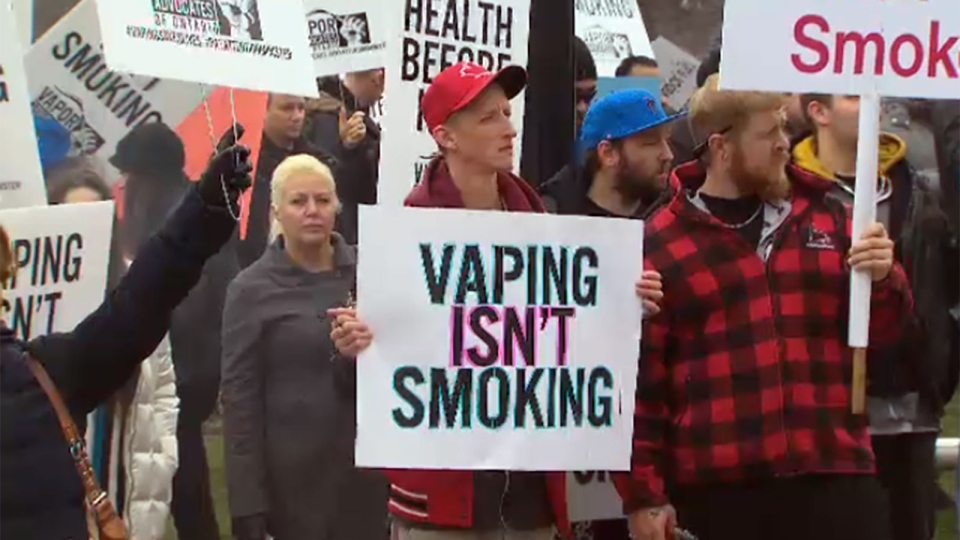
The reaction of the public over the new regulations has led to hundreds of individuals marching to Queen’s Park on Saturday protesting against the proposed restrictions on the use of e-cigarettes throughout the province.
“It’s very damagin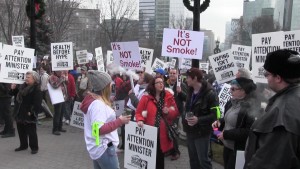 g (to anyone) who wants to quit using cigarettes and wants to use vaping as a way to do that,” Charlie Pisano, the spokesman of Vapor Advocates of Ontario, opined of the proposed new rules.
A law professor at the University of Ottawa, David Sweanor, advocated that the change of legislation will see the hampering in the intentions of those who were looking to put a stop to their deadly smoking habits.
“[They’re] preventing people from using these products, finding out how it works,” he said.
“They’re treating them just like cigarettes in terms of where they can be used. They simply are not like cigarettes.”