
Vaping e-cigarettes can help you quit smoking, a deadly vice you wanted to kick for quite a time already. E-cigarettes, however, can expose you to formaldehyde aerosols, another deadly chemical. For smokers looking for a way out, it is a choice “between the devil and the deep blue sea.” So, what’s the catch? Which is the lesser evil?
The Study
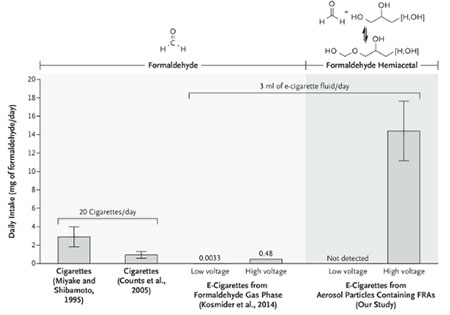
Publishing the results of “Hidden Formaldehyde in E-Cigarette Aerosols” shocked the vaping world. The study revealed that e-cigs expose vapers to high doses of formaldehyde. The formation of any formaldehyde-releasing agent was not initially detected at low voltage of 3.3V. Formaldehyde was only detected when the voltage was already set high at 5.0V. By mathematical extrapolation, a vaper is estimated “to inhale 14.4±3.3 mg of formaldehyde per day in formaldehyde-releasing agents.”
This is even conservative because not all aerosolized liquids was collected and measure using nuclear magnetic resonance (NMR) spectroscopy. That’s a lot of formaldehyde considering tobacco cigarettes only contains about 50μg per stick of cigarette or 3mg per pack (of 20 cigarettes).
What is the implication off the results? The results led the researchers to conclude that it is more potent as a cause of cancer than smoking. There is no reason to doubt the results because the names of people behind the study are oozing with credibility – David H. Peyton, Ph.D., Wentai Luo, Ph.D., James F. Pankow, Ph.D., Robert M. Strongin, Ph.D, and R. Paul Jensen, B.S. Who would think that something is amiss that would necessitate it being put under the magnifying lens of their peers?
Once again, unseen forces are at work. The publication of the results has done its damage. The names of people behind the study are oozing with credibility – David H. Peyton, Ph.D., Wentai Luo, Ph.D., James F. Pankow, Ph.D., Robert M. Strongin, Ph.D, and R. Paul Jensen, B.S. Who would think that something is amiss that would necessitate it being put under the magnifying lens of their peers?
Fortunately, one Dr, Farsalinos did exactly that to unravel a mistake in their methodology that now throw the entire study in question.
The Farsalinos Perspective
Dr. Farsalinos issued an opinion entitled “Verified: formaldehyde levels found in the NEJM study were associated with dry puff conditions. An update.” It highlights several ideas that deserve attention. The most important idea is about the atomizer used in the study. He surmised that it had a resistance of 2.1 ohms capable of delivering 12 watts at a voltage of 5 volts. This is evidently bordering on the so called “dry puff,” which is a red zone in the vaping world. It would overheat the atomizer coil and burn the e-juice causing a nasty taste no sane vaper would want to puff.
Dr. Farsalinos took the initiative to determine the energy levels or watts by using the information provided by the researchers in the published document. He “… considered 3.3 volts as being about 7 watts and 5 volts being 14-16 watts….” The estimate was confirmed based on a Reddit post and the email of the researchers to a user stating that the atomizer used in the study was top-coil CE4 while the battery was Innokin VV V3.0. This confirmed Dr. Farsalinos hypothesis regarding the calculated wattage levels used on the atomizer.
Since the resistance of the atomizer used was 2.1 ohms, it can be concluded that at 3.3V, it delivered 5watts, and that at 5.5 watts, it delivered 12 watts. What is the meaning of this unlocked mystery? The release of extremely high levels of formaldehyde has been triggered by overheating. If no vaper would “dry puff.” Then there is no danger that vapers would ever get that much of formaldehyde.
The Moral Lesson
Scientists must be cognizant that they have the burden of providing humanity with precise, solid and indisputable facts upon which decisions are based. With e-cigarettes fast becoming a symbol of hope for smokers seeking a healthier life, releasing such results and causing confusion is tantamount to killing the hope of these people. It is great that a Farsalino stood up to question the methods. As a matter of practice, researchers must submit their work to a peer review first before releasing those high-impacting results.